Time:2026-03-23
Objects move through physical space and time, generating sequential visuotopic activations in all sighted animals, leading to the visual perception of velocity. Because velocity combines motion direction and speed, motion processing depends on detecting changes in an object’s position over time. Humans can perceive motion direction of a racing car as fast as 400km/h.
A central question in visual neuroscience is how velocity is computed in the brain. Previous studies have shown that the dorsal visual pathway contains direction-selective neurons whose receptive fields increase greatly in size from primary visual cortex (V1) to middle temporal area (MT) and medial superior temporal area (MST). These areas prefer different velocities: V1, MT, and MST are tuned mainly to slow, intermediate, and fast motion, respectively. However, direction-selective neurons in V1, the presumed source of motion signals for MT and MST, lose direction selectivity at speeds above 20km/h. This is a big paradox at the core of our motion perception which encounters the established view in system neuroscience that perception occurs through hierarchical inheritance and elaborates across successive brain areas. Simply when V1 is no longer direction selective at high speeds, how MT and MST can generate their velocity selectivity?
To address this question, Wei Wang's lab recorded neuronal responses to motion velocity ranging from 0 to 180km/h across four successive visual brain stages in awake macaques: the lateral geniculate nucleus (LGN), V1, MT, and MST. They discover that at each cortical stage direction-selective neurons generate velocity selectivity de novo by integrating sequential visuotopic activations from preceding regions, irrespective of cell types and directionality. Their cascaded spatiotemporal integration model, which based on the same spatiotemporal integration mechanism that generates velocity selectivity within the eyes of insects and rabbits, can also explain their findings in primate dorsal visual across a wide range of velocities.
Their discovery of de novo computation of external information deep into the brain's hierarchy is a fundamental advance for our text book knowledge in systems neuroscience, providing a parsimonious explanation challenging the existing dogma of feature inheritance suggesting that motion direction of higher visual areas (MT/MST) is inherited from V1. Thus, by computing velocity anew, primate visual brain effectively uses the cortical hierarchy itself to ‘shift gears’ for efficiently encoding slow and fast motion with small and large receptive fields, respectively. These changing gears to see fast and slow offers insights for information processing in other species, modalities and machine vision.
This study, entitled “De Novo Fast Motion Computation in the Primate Visual Cortex,” was published online in Cell Reports on March 17, 2026. This research was completed over a decade by PhD students Junxiang Luo, Keyan He, and Lixuan Liu at the Institute of Neuroscience, Center for Excellence in Brain Science and Intelligence Technology of the Chinese Academy of Sciences. They share the first authors. Drs. Ye Wang, Dajun Xing and Niall McLough from Communication University of China, Beijing Normal University, and the University of Bradford, UK, respectively also gave substantial contributions to this work. This study was supported by STI2030 Major Projects (2022ZD0204600).
Leading Author Contact: WANG Wei, Center for Excellence in Brain Science and Intelligence Technology of the Chinese Academy of Sciences, Shanghai, China. E-mail: w.wang@ion.ac.cn
Figure legend:
De Novo Fast Motion Computation in the Primate Visual Cortex
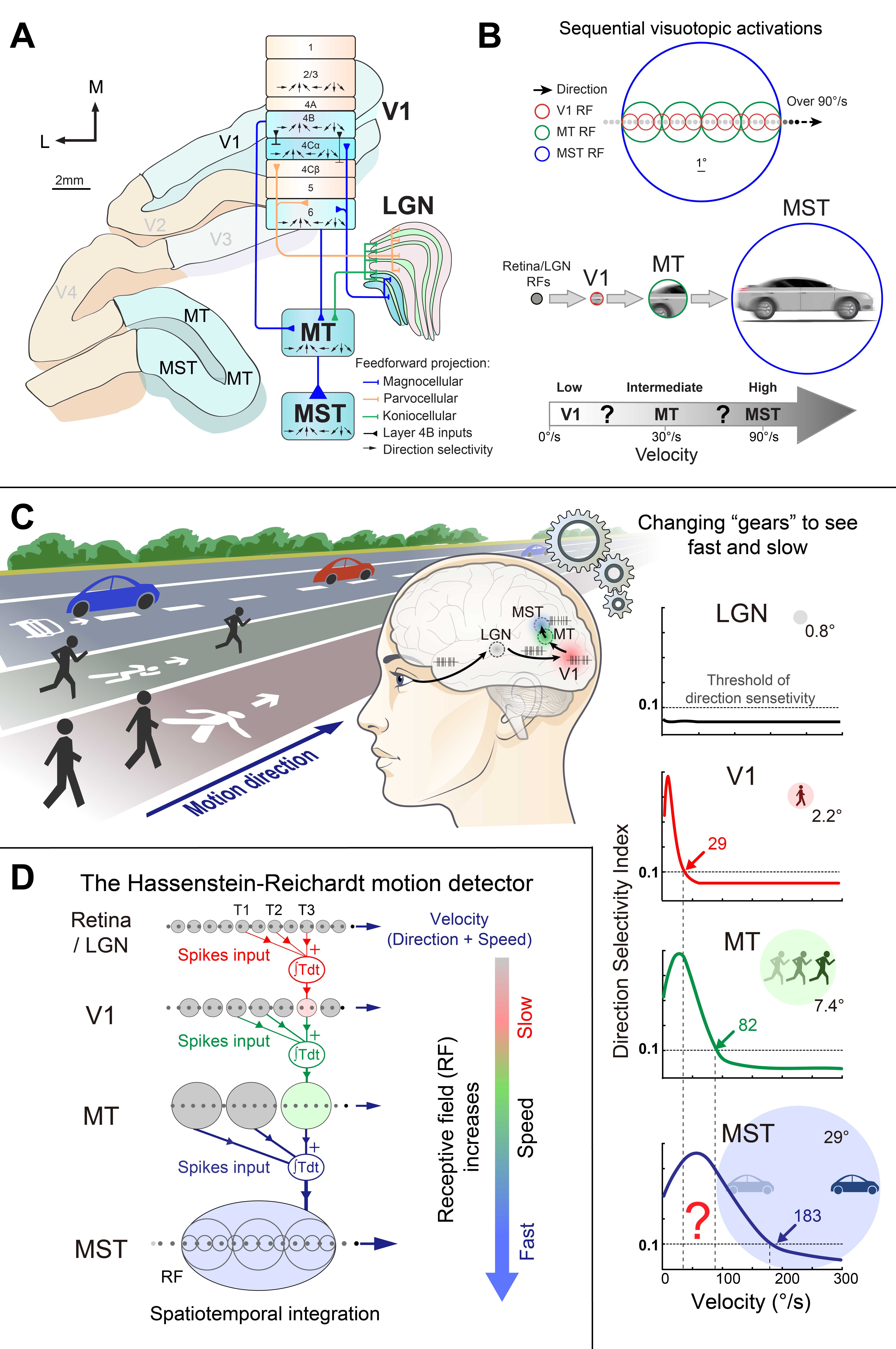
(A) The dorsal visual pathway in primates. (B) The size of the receptive field of detection-selective neurons is positively correlated with the speed of the encoded motion. (C) The shifting gears along the primate dorsal visual hierarchy encoding fast and slow velocities. (D) The diagram of a cascaded spatiotemporal energy integration model.
 附件下载:
附件下载: 
