Time:2026-06-12
On June 11, 2026, Nature published an Article entitled “A Thalamus–Brainstem Attractor Network Drives History-Biased Decisions.” Using brain-wide single-cell-resolution calcium imaging in larval zebrafish, closed-loop virtual-reality behavior, optogenetic manipulation and neural computational modeling, the study reveals how the brain coordinates multiple computational modules to stably maintain recent experience and flexibly use this information to guide future decisions.
The study was conducted by the research team of Yu Mu at the Center for Excellence in Brain Science and Intelligence Technology, Chinese Academy of Sciences, in collaboration with the research team of Si Wu at Peking University.
In the real world, animals rarely make each decision from scratch. What has just happened often changes the next choice. For example, when animals forage or avoid risks, they often adjust their next movement based on recently acquired cues. This phenomenon, in which recent experience influences current perception and behavior, is known as serial dependence or history bias. It is widely observed in humans, mammals, insects and other animals, and is thought to help the brain exploit temporal continuity in the environment to improve behavioral efficiency. However, previous studies have mainly identified brain regions that carry historical information. How such information is stably maintained, flexibly updated and transformed into future behavior has remained unclear at the whole-brain level.
To address this question, the research team established a closed-loop virtual-reality obstacle-avoidance system for larval zebrafish. In the virtual environment, zebrafish repeatedly encountered obstacles appearing from the left or right, and controlled their own movement through swimming signals. The researchers found that the avoidance response to a current obstacle was not determined only by the current stimulus, but was also significantly influenced by the previous trial and even earlier experience. When two consecutive obstacles appeared on the same side, zebrafish showed a stronger avoidance response. These results indicate that zebrafish can maintain recent experience over tens of seconds and use it to regulate subsequent behavior.
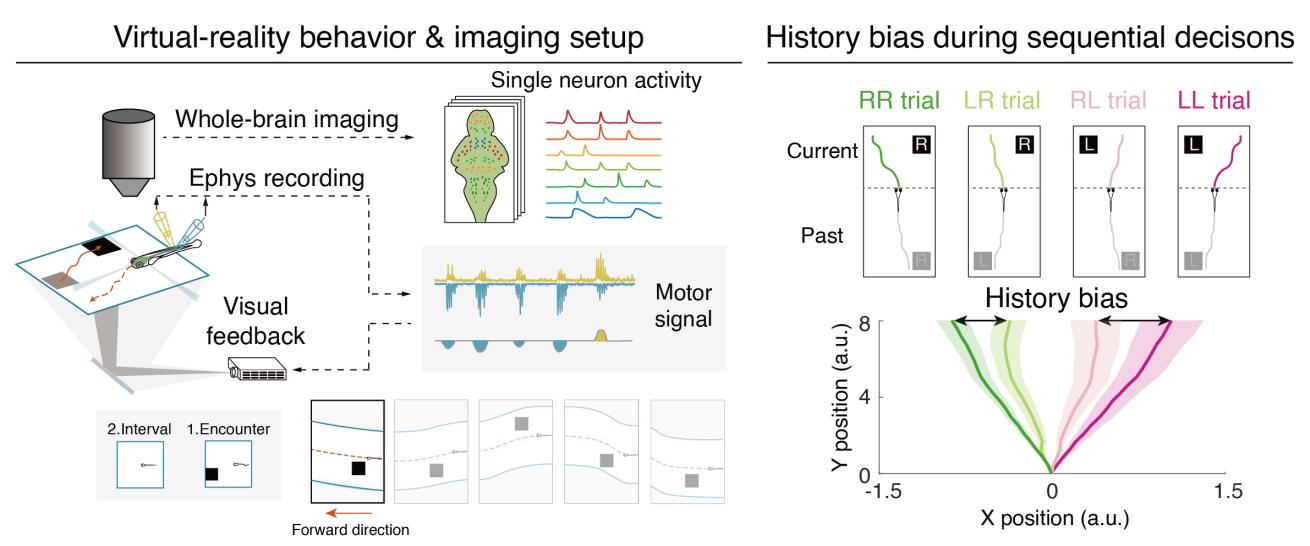
Figure 1 | Virtual-reality experimental design and history-dependent behavior during sequential obstacle avoidance in larval zebrafish
A key technical strength of the study was the ability to record brain-wide neural activity at single-cell resolution during behavior, and to precisely register these activity signals to a standard zebrafish whole-brain atlas established by the teams of Jiulin Du and Xufei Du at CEBSIT. Compared with traditional approaches that examine only local brain regions or small numbers of neurons, brain-wide recording combined with atlas-based registration enabled the researchers to trace, within an intact brain network, the full process by which a sequential decision unfolds from sensory input, memory maintenance and cross-regional integration to behavioral output.
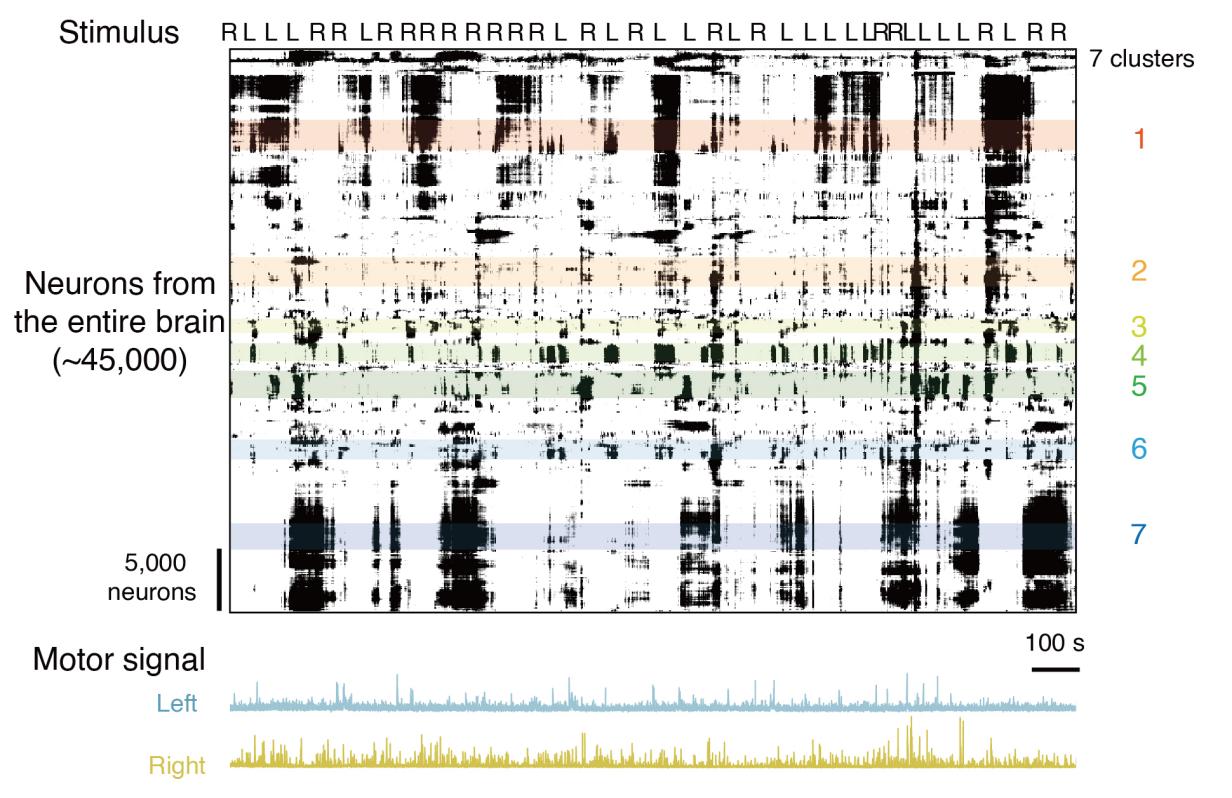
Based on atlas registration, the research team compared simultaneously recorded neurons across brain regions and systematically screened for regions that continued to retain historical information after the obstacle had disappeared. They found that multiple brain regions carried history-related signals, but the dorsal thalamus stood out: it most stably and persistently distinguished whether the most recent obstacle had appeared on the left or right through persistent activity. Further optogenetic experiments showed that inhibiting dorsal thalamic activity abolished history-dependent behavior, whereas unilateral activation of the dorsal thalamus could artificially write in a signal resembling a “past experience,” thereby altering the animal’s next choice. These findings demonstrate that the dorsal thalamus is a key brain region for maintaining recent experience and driving history-biased decisions.
Figure 2 | Brain-wide neural activity recording during behavior and screening of key brain regions
Further analysis showed that the dorsal thalamus does not perform the entire computation alone. Rather, it acts like a “memory switch,” storing the most recent experience as a stable discrete state. Downstream neuronal populations in the brainstem act like an “integrator,” combining historical information provided by the thalamus with current sensory input to generate a continuous signal that reflects multiple recent experiences and ultimately influences behavioral output. In other words, through cross-regional division of labor and coordination, the brain transforms a transient sensory event into an internal state that can be sustained, updated and used to guide future actions.
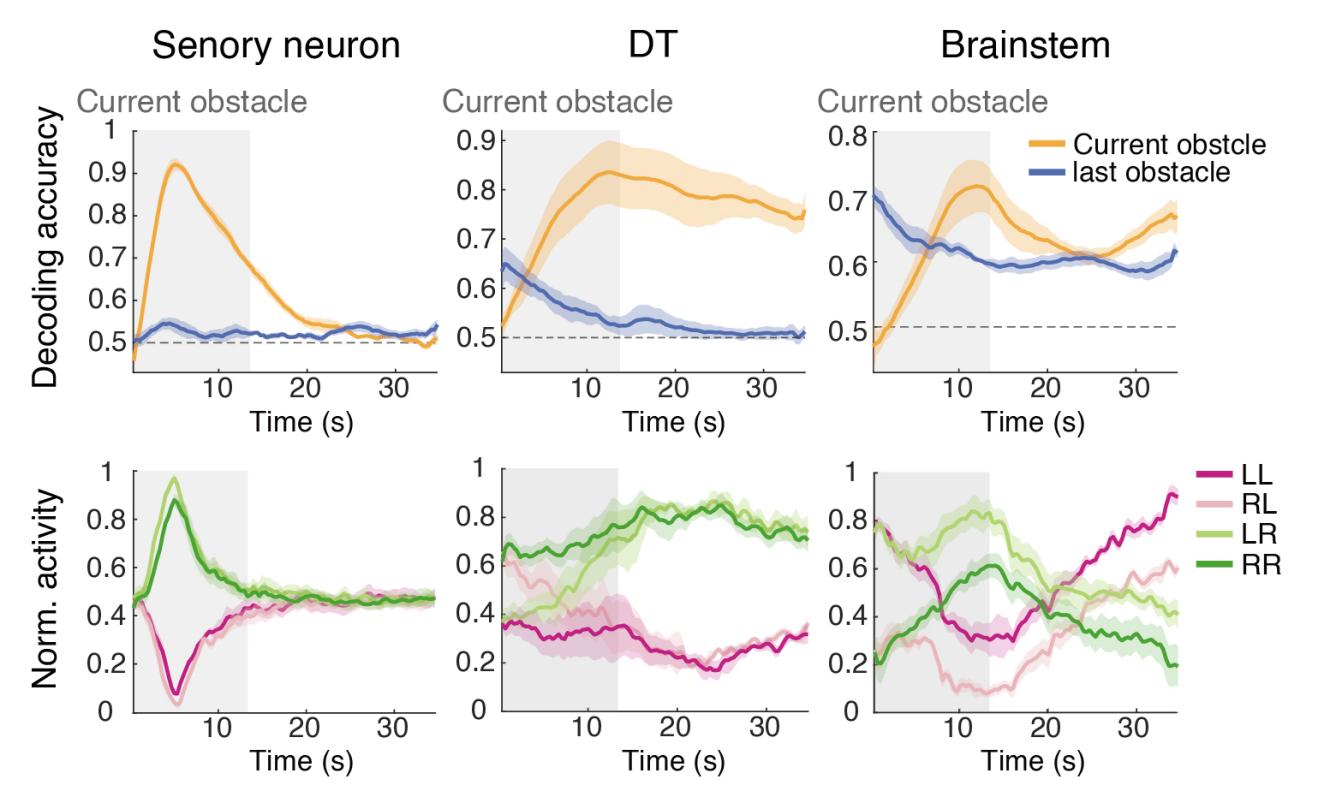
Figure 3 | History information decoding across different computational modules and the underlying neural dynamics
After identifying the key brain regions, the researchers further sought to understand how this cross-regional coordination is implemented in neural networks. They continued to draw on the zebrafish whole-brain atlas resources established by the teams of Jiulin Du and Xufei Du at CEBSIT, incorporating information from the real biological brain—including cell numbers, neuronal types and projection patterns of relevant brain regions—into the modeling process. This enabled the construction of a brain-atlas-constrained whole-brain computational model. Under atlas-based constraints, the model connected a sensory input layer, a thalamic attractor network and a brainstem integrator, reproduced both the sequential decision behavior and the associated neural activity in zebrafish, and revealed the importance of inhibitory-neuron heterogeneity for stable memory and flexible switching.
From a computational perspective, the model proposes a whole-brain attractor–integrator architecture. In this architecture, the thalamic attractor network stores recent experience as a stable discrete state, while the brainstem integrator combines attractor-state transitions with current sensory input to transform transient sensory events into internal states that can continuously influence future behavior. Thus, the model provides innovation at both the level of biological brain structure and neural algorithms, showing that stable memory and flexible updating are not mutually exclusive, but can be jointly achieved through division of labor among different brain regions, neuronal types and dynamical modules.
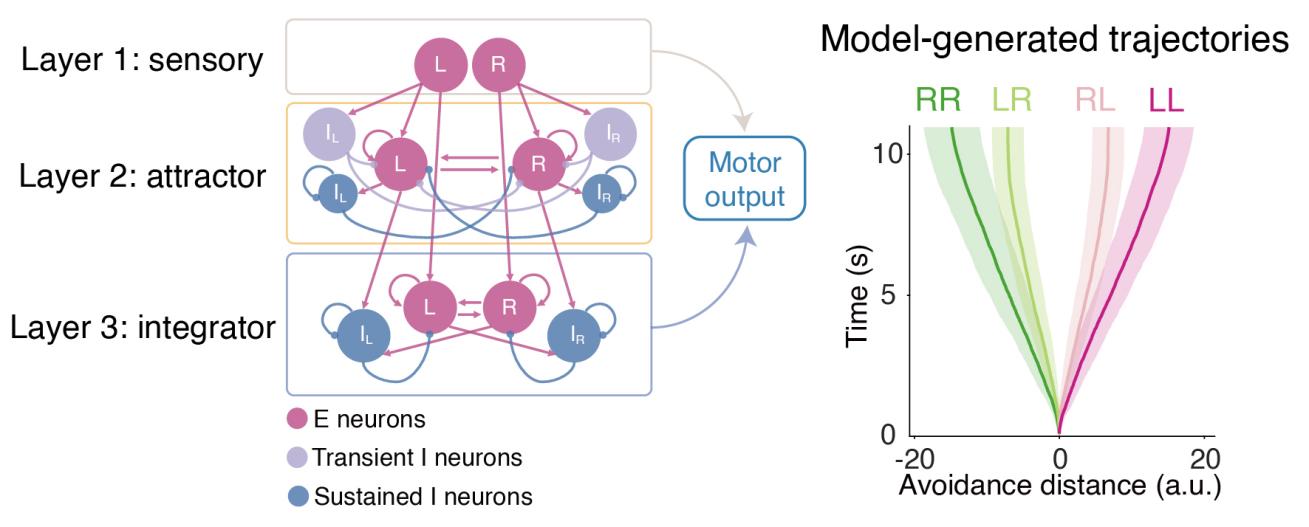
Figure 4 | Architecture, activity and behavioral output of the hierarchical attractor model
This work demonstrates that, under a brain-wide, single-cell-resolution research paradigm, a whole-brain atlas is not only an anatomical resource, but can also serve as an important bridge between real brain structure and principles of neural computation. Further extensions of the model suggest that similar architectures may support longer-timescale memory expansion and sensorimotor closed-loop control. In this sense, the whole-brain model not only explains how zebrafish use past experience to influence their next choice, but also provides biological inspiration for future embodied-intelligence systems and autonomous machine control.
CEBSIT doctoral students Shan Zhao and Heying Shan, together with Peking University doctoral student Xiao Liu, are co-first authors of the paper. Yu Mu, Investigator at CEBSIT, and Professor Si Wu at Peking University are co-corresponding authors. The zebrafish whole-brain atlas resources developed by the teams of Jiulin Du and Xufei Du at CEBSIT provided a key foundation for whole-brain functional activity localization, brain-region analysis and atlas-constrained modeling in this study, and their teams made important contributions in brain-atlas resources and data analysis. The team of Ling Fu at Hainan University provided important support in imaging technology, and the team of Kai Wang at CEBSIT provided important support in optogenetic manipulation. This work was supported by the Ministry of Science and Technology of China, the National Natural Science Foundation of China, the Chinese Academy of Sciences and other funding sources.
 附件下载:
附件下载: